
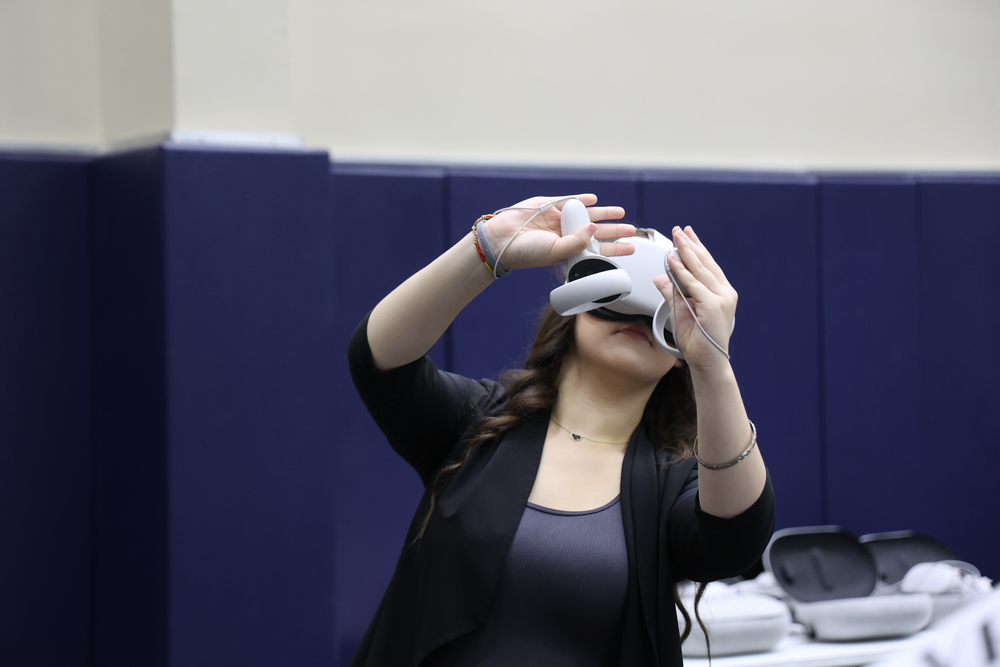
As part of a pilot program using Virtual Reality (VR) Goggles to teach students about career pathways, more than 1,100 middle and high school students in SAISD have had some very vivid visions experiencing potential careers.
In one simulation, students really feel as though they are climbing 300 feet in the air to repair a communications tower. In another, as an HVAC repair technician, spiders run out of the unit toward the person in the simulation. For some students, their experience is exhilarating and affirming of their career pathway. Other times, there can be some mind-changing.
“I went in thinking I wanted to be a doctor, but after doing a surgery simulation, I changed my mind,” a sixth grade Advancement Via Individual Determination (AVID) student at Davis Middle School said. “There was blood splatter, and I could see bone, and that is something I don’t think I ever want to see in person. I was able to find another job in engineering that I am interested in now.”
This discernment process — thinking and rethinking careers — is exactly what the district’s Career and Technical Education Department team was hoping would happen when they invested in 30 VR Goggle sets this year. The decision to acquire the sets was made after the SAISD Foundation bought eight sets last year to use on their STEM buses — and students were hooked.
“These VR goggles serve as a bridge between imagination and opportunity,” said Katheryn Cline, director of Career and Technical Education. “We’re using this immersive technology to broaden our scholars' horizons, helping them discover and pursue high-impact careers they never knew were possible.”
Throughout the year, the goggles have been piloted with middle school students in AVID and Leadership Officer Training Corps (LOTC) programs with the assistance of District AVID Coordinator Dr. Cynthia Martinez, who developed a four-day sequence of lessons to accompany the use of the goggles. The lessons are designed to expose students to possible career clusters before they must select a high school endorsement (STEM, Business & Industry, Public Service, Arts & Humanities, and Multi-Disciplinary Studies) as mandated by the Texas Legislature in 2013.
“The intent is to provide some early career awareness and exposure to middle school scholars so that when they make their choices, they’re a little bit more informed about what it looks like,” Martinez said. “In AVID, one of our scholar outcomes is opportunity knowledge, which includes college and career awareness. And LOTC does a lot of career awareness as well.”
When a school requests the program, Martinez meets with the teacher to train them before the four-step lesson is deployed. Much of the content is delivered by Transfr, a maker of career exploration software that creates the VR simulations. Day one is a general lesson on career awareness. Day 2 two moves on to career clusters. On Day 3, students complete the Transfr Trek interest inventory, a survey of 23 yes or no career preference questions, such as whether students like working with their hands, working with numbers, or working alone or in teams. Once the inventory is complete, the system matches students to careers.
"They have all the information you can need on a career,” Martinez said. “It has a description, it has what skills you need. It has how much money you would make, and it's relative to our area. It also has information about a pathway — what do you need to do in high school? What classes do you need to take? Do you need a certification? Are there institutions close to us that have this career major?”
Students are able to make a budget and see what life would be like if they pursued that career.
“It was great exploring different careers and how much they pay,” said Perla, an eighth grade LOTC student at Hot Wells Middle School. “It gives me an idea of how I want to pay my bills when I get older.”
There are currently 60 different simulations for students to choose from based on the results of their inventories. After students receive a list of potential careers, that’s when the experiential learning begins, virtually at least. Students are instructed to choose the careers that intrigue them most for the career simulations in VR, with the goal of every scholar completing at least two simulations.
“The VR career exploration goggles really gave the students a sense of whether they would like a certain career field,” said Jasmine Collins, AVID teacher at Davis College Preparatory Middle School. “This opportunity gives the students virtual experience to jobs they may never have a chance to experience until they are in that career field.”
As the middle school students make endorsement choices and fill out choice cards, many are choosing CTE pathways. Based on the knowledge they have gained in the simulations, they are now better equipped to complete their pathway all the way to industry certification, making better use of the high school courses they can take for free.
“We know that for accountability, being a completer in a CTE program is very important,” Martinez said. “So if we can help them make an informed choice early, hopefully they will stay the whole four years and get their certification.”
So far more than 1,000 middle school students have completed the simulations, with the top simulation choices being registered nurse, firefighter, and veterinarian technician.
While the pilot has been aimed at middle school students on the precipice of making high school choices, there are plenty of applications to extend beyond the pilot into high school classrooms.
The simulations can be used to provide high school students in CTE programs a realistic view of the tasks required in a profession earlier in their high school careers, even as they still learn theory and safety in their lower-level classes.
“It will be a good way to capture them in ninth and 10th grade and show them what the hands-on part will look like,” Martinez said.
At the recent SAISD Scholars Job Fair, more than 100 students tried the simulations, choosing from 20 different careers that encompassed all CTE pathways in the district. Even presenting employers tried the simulations and came away impressed by how realistic they felt.
“They told us, ‘wow, that was real,’” Martinez said.
That kind of reaction shows the pilot project is giving students meaningful, hands-on insight into their future careers.
Las gafas VR dan vida a las posibles carreras profesionales
Como parte de un programa piloto que utiliza gafas de Realidad Virtual (VR) para enseñar a los estudiantes sobre las trayectorias profesionales, más de 1,100 estudiantes de secundaria y preparatoria en SAISD han tenido algunas visiones muy vívidas experimentando carreras potenciales.
En una simulación, los estudiantes realmente sienten que están escalando 300 pies en el aire para reparar una torre de comunicaciones. En otro, como técnico de reparación de HVAC, las arañas salen corriendo de la unidad hacia la persona en la simulación. Para algunos estudiantes, su experiencia es estimulante y afirmativa de su trayectoria profesional. Otras veces, puede haber algún cambio de mente.
“Entonces pensé que quería ser médico, pero después de hacer una simulación de cirugía, cambié de opinión”, dijo un estudiante de sexto grado de Avance Vía Determinación Individual (AVID) en Davis Middle School. “Había salpicaduras de sangre, y pude ver hueso, y eso es algo que no creo que quiera ver en persona. Pude encontrar otro trabajo en ingeniería que me interesa ahora”.
Este proceso de discernimiento — pensando y repensando las carreras — es exactamente lo que el equipo del Departamento de Educación Técnica y Carrera del distrito esperaba que suceda cuando invirtieron en 30 sets de Goggle VR este año. La decisión de adquirir los sets se tomó después de que la Fundación SAISD compró ocho sets el año pasado para usarlos en sus autobuses STEM, y los estudiantes fueron enganchados.
“Estas gafas de realidad virtual sirven como un puente entre la imaginación y la oportunidad”, dijo Katheryn Cline, directora de Carrera y Educación Técnica. “Estamos utilizando esta tecnología inmersiva para ampliar los horizontes de nuestros académicos, ayudándolos a descubrir y seguir carreras de alto impacto que nunca supieron que eran posibles”.
A lo largo del año, las gafas han sido piloteadas con estudiantes de secundaria en los programas de AVID y del Cuerpo de Entrenamiento de Oficiales de Liderazgo (LOTC) con la asistencia de la Coordinadora del Distrito AVID, Dra. Cynthia Martínez, quien desarrolló una secuencia de cuatro días de lecciones para acompañar el uso de las gafas. Las lecciones están diseñadas para exponer a los estudiantes a posibles grupos de carreras antes de que deban seleccionar una aprobación de la prepartortia (STEM, Negocios e Industria, Servicio Público, Artes y Humanidades, y Estudios Multidisciplinarios) según lo mandado por la Legislatura de Texas en 2013.
“La intención es proporcionar un poco de conciencia y exposición temprana a los estudiantes de la escuela intermedia para que cuando toman sus decisiones, estén un poco más informados sobre cómo se ve”, dijo Martínez. “En AVID, uno de nuestros resultados académicos es el conocimiento de oportunidad, que incluye la conciencia universitaria y profesional. Y LOTC también hace mucha conciencia profesional”.
Cuando una escuela solicita el programa, Martínez se reúne con el maestro para entrenarlos antes de que se despliegue la lección de cuatro pasos. Gran parte del contenido es entregado por Transfr, un fabricante de software de exploración de carreras que crea las simulaciones de RV. El primer día es una lección general sobre la conciencia profesional. El día 2 pasa a los grupos de carreras. El día 3, los estudiantes completan el Inventario de Interés de Transfr Trek, una encuesta de 23 preguntas de preferencia profesional sí o no, como si a los estudiantes les gusta trabajar con sus manos, trabajar con números o trabajar solos o en equipos. Una vez que el inventario está completo, el sistema hace coincidir a los estudiantes con las carreras.
"Tienen toda la información que puedes necesitar sobre una carrera", dijo Martínez. “Tiene una descripción, tiene qué habilidades necesitas. Tiene cuánto dinero ganarías, y es relativo a nuestra área. También tiene información sobre una vía — ¿qué necesitas hacer en la preparatoria? ¿Qué clases necesitas cursar? ¿Necesitas una certificación? ¿Hay instituciones cercanas a nosotros que tengan esta carrera principal?”
Los estudiantes son capaces de hacer un presupuesto y ver cómo sería la vida si siguieran esa carrera.
“Fue genial explorar diferentes carreras y cuánto pagan”, dijo Perla, una estudiante LOTC de octavo grado en Hot Wells Middle School. "Me da una idea de cómo quiero pagar mis cuentas cuando sea mayor".
Actualmente hay 60 simulaciones diferentes para que los estudiantes elijan en función de los resultados de sus inventarios. Después de que los estudiantes reciben una lista de carreras potenciales, es cuando comienza el aprendizaje experiencial, al menos virtualmente. Se instruye a los estudiantes a elegir las carreras que más les intrigan para las simulaciones de carrera en RV, con el objetivo de que cada académico complete al menos dos simulaciones.
“Las gafas de exploración profesional de RV realmente les dieron a los estudiantes una idea de si les gustaría un determinado campo de carrera”, dijo Jasmine Collins, la maestra de AVID de Davis College Preparatory Middle School. “Esta oportunidad les da a los estudiantes experiencia virtual a trabajos que tal vez nunca tengan la oportunidad de experimentar hasta que estén en ese campo de carrera”.
A medida que los estudiantes de escuela intermedia toman decisiones de aprobación y llenan tarjetas de elección, muchos están eligiendo vías CTE. Basándose en el conocimiento que han adquirido en las simulaciones, ahora están mejor equipados para completar su camino hasta la certificación de la industria, haciendo un mejor uso de los cursos de preparatoria que pueden tomar de forma gratuita.
“Sabemos que, para la rendición de cuentas, ser un completador en un programa CTE es muy importante”, dijo Martínez. “Así que, si podemos ayudarles a tomar una decisión informada temprano, esperamos que se queden los cuatro años completos y obtengan su certificación”.
Hasta ahora, más de 1,000 estudiantes de secundaria han completado las simulaciones, con las mejores opciones de simulación siendo enfermera registrada, bombero y técnico veterinario.
Aunque el programa piloto se ha dirigido a alumnos de secundaria que están a punto de elegir instituto, existen numerosas aplicaciones que permiten ampliarlo más allá de la fase piloto y llevarlo a las aulas de preparatoria.
Las simulaciones se pueden utilizar para proporcionar a los estudiantes de preparatoria en programas de CTE una visión realista de las tareas requeridas en una profesión antes de sus carreras de preparatoria, incluso cuando todavía aprenden teoría y seguridad en sus clases de nivel inferior.
“Será una buena manera de capturarlos en noveno y décimo grado y mostrarles cómo será la parte de práctica”, dijo Martínez.
En la reciente Feria de Empleo de Scholars SAISD, más de 100 estudiantes probaron las simulaciones, eligiendo entre 20 carreras diferentes que abarcaron todas las vías de CTE en el distrito. Incluso los empleadores que presentaban las simulaciones probaron y salieron impresionados por lo realistas que se sentían.
“Nos dijeron, ‘wow, eso fue real’”, dijo Martínez.
Ese tipo de reacción muestra que el proyecto piloto está dando a los estudiantes una visión práctica y significativa de sus futuras carreras.